
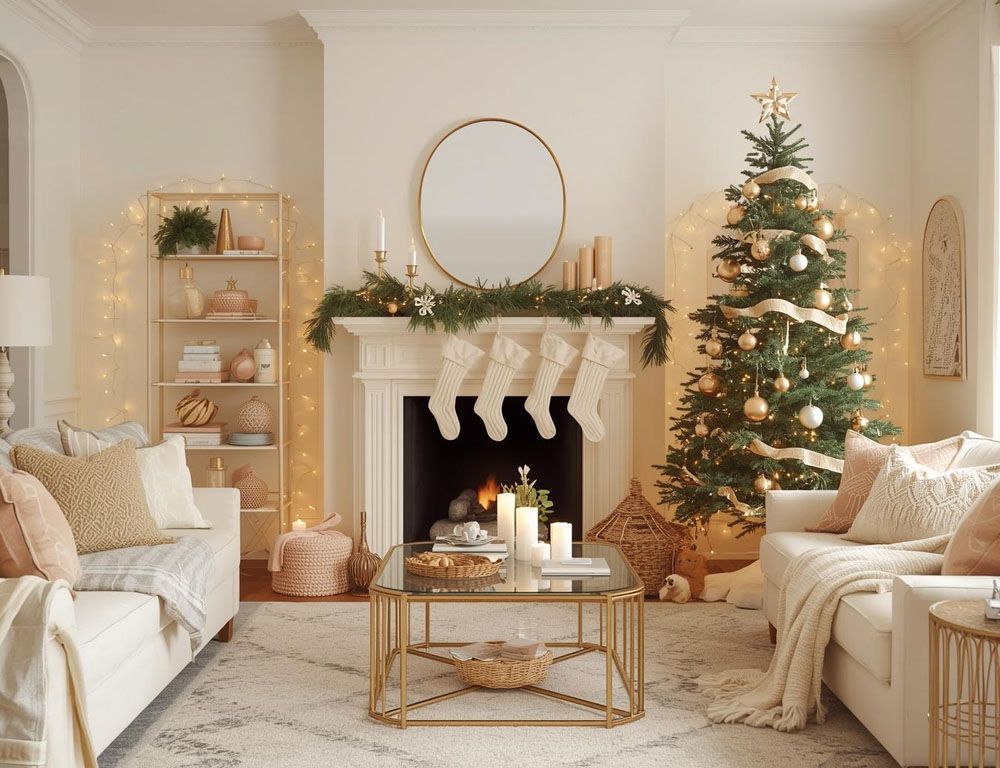
Holiday decorations for indoors do not have to begin and end with the Christmas tree. In many homes, the strongest seasonal atmosphere comes from places used every day: the mantel, entryway, dining table, windows, staircase, kitchen, and lighting that changes how those spaces feel after dark.
Decorating them well is partly about restraint. A garland should not make a doorway awkward, a centerpiece still needs to leave room for dinner, and ornaments lose some of their effect when every useful surface is covered. Instead of giving each room a separate theme, choose a few colors and materials that can reappear in different ways throughout the house.
That leaves room for ordinary furniture, books, artwork, and the objects already associated with home. Good indoor holiday decor ideas make familiar rooms feel seasonal without hiding what made them comfortable in the first place.
Plan Indoor Holiday Decorations Around the Rooms You Use Most
Start with the spaces that will actually be occupied during the season. A formal room that is rarely used does not necessarily deserve more decorating time than the kitchen, living room, or entryway people pass through several times a day.
Pick two or three areas to carry most of the visual weight before opening every storage box. The living room might come first, followed by the dining area and entryway. Smaller decorations can then connect those spaces without requiring a wreath, figurine, garland, or string of lights on every wall.
A simple holiday color palette makes this easier. Greenery and warm white lights can provide the base, while ribbon, ornaments, flowers, textiles, or metallic finishes bring in color. Repeating one material in several rooms often creates more continuity than buying matching collections for each one.
| Room or Space | Useful Focal Point | Holiday Decorations That Fit | Common Constraint |
|---|---|---|---|
| Living room | Mantel, tree area, main wall | Greenery, lights, ornaments, textiles | Decor covering every table and shelf |
| Entryway | Console, door, stair rail | Wreaths, garlands, lanterns, branches | Narrowing the path into the house |
| Dining room | Table or sideboard | Runner, candles, greenery, ornaments | Tall or oversized centerpieces |
| Kitchen | Window, open shelf, counter edge | Small wreaths, branches, seasonal textiles | Decorations near heat or prep areas |
| Small apartment | Wall, window, shelf | Lights, compact greenery, slim displays | Large floor-standing decorations |
The table is less a shopping list than a way to decide where decoration will have the most impact without making the room harder to use.
Living Room Holiday Decor Beyond the Christmas Tree
The living room often carries most of the seasonal detail because people spend more time there and the room already has several natural focal points. The Christmas tree may be the largest one, but treating it as the only decorated area can make everything around it feel disconnected.
Look at what surrounds it. A fireplace, sofa, large window, bookcase, or console can repeat one or two details from the tree without copying the entire arrangement. If the tree uses burgundy ribbon and brass-toned ornaments, the mantel might repeat the ribbon while a side table picks up the metallic finish in a candleholder or tray.
If the tree needs more attention, these indoor Christmas tree decorations offer ideas for ornaments, placement, and the surrounding display. The rest of the living room can then develop quieter layers instead of repeating the same treatment around every surface.
Mantel Decorations With Greenery, Lights and Ornaments
Good holiday mantel decor usually has more variation than a straight row of objects at equal height. Greenery gives the mantel a base, while candlesticks, framed pieces, ceramic houses, branches, or a few larger ornaments break up the horizontal line.
Symmetry is optional. An asymmetrical garland can suit a fireplace that is already architecturally balanced, and a few larger objects often read more clearly than many small decorations packed together.
If the fireplace is used, decorative materials need generous clearance from heat and flames. Ribbon, paper ornaments, greenery, stockings, and other combustible pieces should stay out of the active area around the fire.
Holiday Decorations for Shelves and Windows
Bookshelves do not have to be emptied before seasonal pieces appear. Leave most books and everyday objects where they are, then shift a few smaller items to make room for ornaments, branches, greenery, or seasonal artwork.
Windows offer a different opportunity because some decorations are visible from both sides. A wreath, hanging ornaments, paper stars, or a restrained light string may be enough, especially if the room already has a strong tree or mantel.
Window sills suit low arrangements. A narrow vase with branches or several ornaments grouped on a tray creates a seasonal note while still leaving the window easy to open and clean.
Holiday Entryway and Staircase Decor Ideas
The entryway is usually seen before any other decorated room, but it is also where shoes, coats, bags, keys, packages, and people compete for space. A few deliberate decorations work better here than a dense display.
A console may hold greenery, branches, lights, or ornaments while leaving part of the surface available. Wreaths do not have to remain on exterior doors either. An interior door, mirror, or wall above a console can be a better location when weather or constant door movement makes the front awkward.
Staircases already provide a long architectural line, so even a simple garland makes an impression. There is little reason to wrap every spindle if doing so makes the handrail uncomfortable to use.
Hanging Garlands Indoors Without Damaging Walls
Lightweight garlands can often be supported by removable hooks, tension rods, over-door hangers, curtain rods, shelving, or sturdy parts of a staircase. The attachment method should match the weight of the decoration rather than relying on tape or undersized hooks.
Lighted garlands need an extra check because damaged cords create a different problem from a fallen branch of faux greenery. NFPA’s winter holiday safety guidance recommends using clips instead of nails for holiday lights and replacing strings with worn cords or loose connections.
Dining Table and Kitchen Holiday Decorations
Dining rooms can carry plenty of seasonal color without becoming displays that have to be dismantled at every meal. A runner, greenery, candles, flowers, ornaments, or seasonal napkins may establish the palette while leaving room for serving dishes and glasses.
Sideboards and buffets are better locations for taller pieces. Branches, small decorative trees, framed seasonal art, or candlesticks add height there without sitting between people at the table.
Kitchen holiday decorations deserve a lighter touch. Small wreaths on selected cabinet doors, greenery near an open shelf, a vase of winter branches, or seasonal textiles add atmosphere without sacrificing the counter space needed for cooking.
Keep Holiday Table Decorations Practical
One of the easiest checks is to imagine the finished table with food actually on it. If serving bowls, plates, glasses, and seated guests no longer fit comfortably, the centerpiece is too demanding regardless of how attractive it looks while the room is empty.
Low arrangements suit seated meals because conversation can continue across them. Taller decorations make more sense toward the back of a buffet or sideboard, where height adds interest without becoming a barrier.
The table also does not need an entirely separate decorating scheme. Repeating a ribbon color, greenery type, ornament shape, or metal finish is enough to connect it with nearby rooms.
Indoor Holiday Lighting for a Warm Evening Atmosphere
The most useful indoor holiday lighting ideas add another layer to a room’s normal lighting instead of replacing it. Floor and table lamps keep the space comfortable, while light strings, illuminated window decorations, or battery candles provide the seasonal glow.
Warm white lights tend to sit comfortably beside wood, greenery, textiles, and candle-like light. Cooler white can suit silver, clear glass, blue, or a more contemporary palette. Problems usually appear when noticeably different light temperatures compete within one small room.
Cord placement deserves attention before the decorations are finished. An extension lead crossing a doorway or route between furniture quickly becomes more noticeable than the lights themselves.
The U.S. Consumer Product Safety Commission’s holiday safety guidance recommends checking holiday lights for damage and avoiding unattended candles. Flameless candles are especially useful around greenery, fabric, paper, or busy areas.
Holiday Decorating Ideas for Small Homes and Apartments
Small rooms do not need miniature versions of every decoration used in a large house. They benefit more from careful placement because floor space, storage, and clear surfaces become limited much sooner.
Holiday decorations for small apartments are often easier to manage when walls, windows, shelves, and existing furniture carry more of the visual weight. A slim tree may fit where a wide one would dominate the room, while a tabletop tree works well in a studio or compact living area.
Textiles are especially useful in small spaces because they add color and texture without taking up floor space. A throw, cushion covers, seasonal bedding, or a table runner can change the mood without introducing another freestanding object.
Make Small-Space Holiday Decor Feel Intentional, Not Crowded
Choose one area for the strongest seasonal treatment. It might be a compact tree, decorated window, shelf, or wall above a console. Other parts of the room only need to echo a color, material, or light source from that focal point.
Many tiny decorations can make a small room feel busier than one substantial arrangement. Leaving a few shelves and surfaces unchanged gives the decorated areas more visual weight.
Storage should influence purchases as well. Foldable textiles, flat paper decorations, compact lights, ribbons, and nested containers are much easier to live with after the season than bulky props that spend eleven months taking up cupboard space.
DIY Holiday Decorations and Budget-Friendly Ideas
DIY decorating is most useful when it fills an actual gap rather than creating another collection of small objects. Natural materials, paper, ribbon, fabric remnants, existing containers, and spare ornaments offer plenty of possibilities without requiring many new supplies.
Some budget-friendly holiday decorations worth making or assembling at home include:
- paper stars or snowflakes grouped in a window instead of scattered around the room;
- greenery garlands finished with ribbon already used elsewhere in the house;
- dried citrus, pinecones, or branches arranged in bowls and vases;
- spare ornaments grouped inside clear glass containers;
- handmade place cards or simple napkin details for the dining table;
- existing frames temporarily filled with seasonal prints or family photographs.
Choose the project according to what the room lacks. If the mantel is already visually full, another garland will not add much. The same hour might have far more impact on a bare entryway or dining table.
Budget decorating becomes easier when new purchases are additions to a reusable base. Ribbon, a small group of ornaments, or a different textile can alter the mood without replacing garlands, lights, trays, vases, and other pieces that still have years of use left.
Reusable Holiday Decorations You Can Restyle Each Year
Reusable decorations do not have to return to exactly the same places every December. Their value comes from being flexible enough to participate in different arrangements.
A plain green garland might have velvet ribbon one year and dried citrus the next. Clear ornaments can move from the tree to a bowl or dining-table arrangement, while brass or silver candleholders may shift between the mantel, entryway, sideboard, and table.
The same principle works with broader seasonal home decor: a useful base remains while smaller details change with the time of year. Older decorations become easier to combine with a few new pieces instead of being replaced whenever tastes change.
Storage plays a role here too. Clearly labeled boxes, smaller containers for fragile pieces, and lights stored separately from ribbons and greenery make it easier to see what is already available before another shopping trip begins.
Common Indoor Holiday Decorating Mistakes
Most decorating mistakes happen after a room already feels finished and another object is added anyway. Seasonal rooms still need quieter areas where the eye can rest.
Before calling the setup complete, check for:
- garlands, baskets, or decorations narrowing normal walking routes;
- too many unrelated colors or finishes competing in one room;
- tall table decorations blocking conversation;
- lights or extension cords crossing areas where people walk;
- candles placed too close to greenery, fabric, paper, or other decorations;
- every shelf, counter, and table covered with seasonal objects.
Look at the rooms again after dark. Reflections, light temperature, illuminated garlands, and window lights change the balance, and an arrangement that seemed restrained during the afternoon may suddenly feel much busier.
It is also worth leaving ordinary objects visible. Books, artwork, ceramics, furniture, and family photographs give the decorations context instead of making the house feel as though its usual personality has been packed away for December.
Holiday decorations for indoors are most successful when familiar spaces feel different without becoming harder to use. A decorated mantel, practical dining table, welcoming entryway, a few well-lit windows, and repeated details from room to room create plenty of seasonal atmosphere without requiring decoration on every surface.
Once the main areas feel connected, adding more rarely improves the result. A few quieter spaces usually make the holiday details that are already there look stronger.