
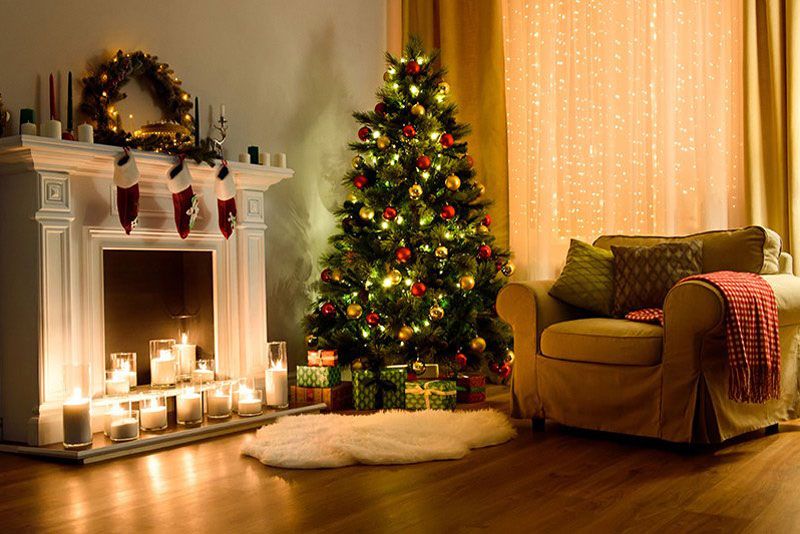
Indoor Christmas tree decorations look more balanced when the tree is treated as one composition rather than a place to hang everything in the storage box. Lights create depth, ribbon or garland adds movement, larger ornaments establish the main rhythm, and smaller pieces fill the remaining gaps.
Order and proportion matter more than simply adding more ornaments. A loose plan also makes it easier to mix sentimental pieces, new decorations, different finishes, and a few imperfect favorites without ending up with one crowded side and another that feels unfinished.
Choose a Christmas Tree Style Before You Start Decorating
Before opening ornament boxes, decide what should hold the tree together visually. This does not require buying coordinated sets. A color family, repeated finish, or one ribbon can provide enough structure.
| Tree Style | Main Colors | Ornament Finishes | Ribbon or Garland | Topper Direction |
|---|---|---|---|---|
| Traditional | Red, green, gold | Glossy glass, metallic, painted | Velvet or plaid | Star or angel |
| Snowy | White, silver, icy blue | Clear, frosted, crystal-like | White or silver ribbon | Snowflake or pale star |
| Natural | Green, brown, cream | Wood, matte glass, dried elements | Twine or wood beads | Wood or woven star |
| Modern | Champagne, black, white, muted tones | Matte, glass, restrained metallics | Thin velvet or satin | Simple sculptural topper |
The categories can overlap. A traditional tree can carry handmade ornaments, and a modern tree does not need every bauble to come from the same collection. Repeating one or two elements often creates enough continuity.
Decorate a Christmas Tree in the Right Order
A practical decorating order prevents later layers from fighting with earlier ones. Ribbon is harder to tuck naturally after fragile ornaments are hanging, while lights are frustrating to adjust once the tree is covered.
Start With Christmas Tree Lights
Christmas tree lights should appear at more than one depth. Work some strands closer to the trunk and others along the outer branches so the tree glows from inside instead of shining only around its surface.
Start low and work upward, checking the distribution as you go. Before adding anything else, turn down the normal room lighting and look at the tree from several feet away. Dark patches, overly bright clusters, and obvious loops of wire are much easier to correct now than after the ornaments are in place.
Add Ribbon or Garland Before the Ornaments
Christmas tree ribbon looks more natural when it creates movement instead of circling the tree in rigid horizontal bands. Vertical drops can emphasize height, while shorter diagonal sections soften a broad tree.
Wired ribbon is easier to shape because loops and folds stay in place between branches. Better Homes & Gardens’ Christmas tree ribbon advice uses a tuck, loop, tuck, tail approach, which is useful when shorter shaped sections suit the tree better than one continuous band.
Once the lights and ribbon are settled, a practical order is:
- place the largest ornaments first;
- add medium ornaments across the remaining branches;
- use smaller pieces where the tree still looks thin;
- give sentimental ornaments visible positions;
- add picks or fillers only where a real gap remains;
- finish with the topper and tree skirt or collar.
This leaves the strongest branches available for heavier or more important pieces instead of filling them too early.
Mix Christmas Ornaments by Size Shape and Finish
A tree made from identical Christmas ornaments can look flat even when the palette is attractive. Mixing sizes and finishes keeps the tree from looking flat, even when most ornaments stay within the same palette.
Place some larger ornaments deeper inside the tree, especially where there are visible gaps. Medium pieces can repeat the main colors across the branches, while smaller ornaments work well near branch tips and through the narrower upper section.
Finish matters too. Matte surfaces absorb light, glossy ornaments reflect nearby colors, clear glass allows greenery to show through, and metallic pieces pick up highlights. Two or three finishes within one palette usually create more depth than adding several extra colors.
Sentimental ornaments do not need to match perfectly. A handmade piece or an old family decoration can sit outside the palette and still belong if it has enough space to be noticed.
How to Space Ornaments Without Leaving Bare Patches
Avoid completing one branch or one side at a time. Place several large ornaments around the visible tree first, then return with the next size. Uneven clusters are easier to notice before the smallest decorations go on.
Not every ornament needs to hang from an outer tip. Moving some pieces several inches inward creates layers and reduces the flat wall-of-baubles effect. Repeated ornaments also look less mechanical when they appear at different heights rather than in obvious rows.
A little exposed greenery is useful. Bare branches between ornament groups give individual pieces room to show and prevent a full tree from becoming visually heavy.
Decorate the Tree From Several Viewing Angles
Judge the tree from the doorway, sofa, or dining area rather than only from arm’s length. A gap that disappears while you are beside the branches may be obvious from the place where the tree is seen most often.
A freestanding tree needs attention on several sides, while one against a wall can carry more decoration on the front and visible edges. If nearby holiday decorations for indoors already use a strong color or metallic finish, repeating a smaller amount on the tree can connect the room without turning everything into a matching set.
Christmas Tree Color Schemes That Work Indoors
The easiest Christmas tree color schemes use one main color, one supporting shade, and a smaller accent. That leaves enough flexibility for older ornaments and handmade pieces that sit outside the planned palette.
Traditional red, green, and warm gold work naturally against evergreen branches, while white, silver, clear glass, and pale gray create a cooler snowy look. Natural combinations can rely on cream, wood, muted green, dried elements, and matte finishes instead of obvious metallic shine.
For a more modern tree, champagne with black, burgundy with blush, dark green with cream, or white with one muted accent can all work. Start with the room rather than the ornament aisle: darker furniture may benefit from pale or reflective decorations, while a bright interior can usually carry deeper colors without becoming visually heavy.
Indoor Christmas Tree Decorations for Small Living Rooms
Indoor Christmas tree decorations for small living rooms need to respect the available floor space. A slim or pencil tree can preserve a normal walkway while still providing enough height to become the room’s main Christmas feature.
Fewer, larger ornaments often work better than many tiny ones because their shapes remain clear from across a compact room. A limited palette also reduces visual noise when the tree sits close to furniture, shelves, and everyday objects.
A few choices make the biggest difference:
- choose a slim tree before sacrificing a normal walkway;
- decorate the front and visible sides more heavily if the back faces a wall;
- use fewer ornament families rather than many unrelated styles;
- keep the skirt or collar proportionate to the tree’s footprint;
- repeat one tree color elsewhere in the room instead of adding more Christmas objects;
- leave some open floor space around the base.
The tree already provides plenty of color, texture, and light. Keeping nearby surfaces quieter gives it more visual space.
Make a Slim Christmas Tree Look Full
A slim tree looks fuller when the decorations follow its proportions instead of trying to imitate the width of a standard tree. Medium and larger ornaments should be distributed through the visible front and sides rather than concentrated in one horizontal band.
Vertical ribbon works particularly well because it follows the narrow shape and draws the eye from top to bottom. Avoid oversized garlands or very wide ribbon that visually pushes beyond the tree’s natural outline.
The upper third needs a lighter touch. Smaller ornaments and a topper scaled to the narrow silhouette help the tree feel complete without making the top look disproportionately heavy.
How to Make an Artificial Christmas Tree Look Fuller
Artificial Christmas tree decorations look more convincing once the branches have been fully shaped and the deeper gaps are dealt with first. Start near the trunk and separate compressed branch tips outward rather than fluffing only what is visible from the front.
HGTV’s Christmas tree decorating advice also puts shaping the artificial tree before the decorative layers. Taking a little more time at this stage means fewer ornaments, ribbons, and picks are needed later simply to disguise compressed branches.
Large ornaments can hide deeper holes while still allowing light to pass around them. Ribbon folds cover longer gaps, and a few leafy or berry picks can extend a sparse section without burying the original tree.
If one side is noticeably weaker, rotate the fuller section toward the main viewing area before adding more decoration. In a corner or against a wall, equal density on every side is unnecessary.
Do not try to eliminate every dark gap. A little shadow between the branches makes lights and reflective ornaments more noticeable and keeps the tree from looking packed solid.
Choose a Tree Topper Skirt and Base That Fit the Tree
A tree topper should feel like the final part of the composition rather than a separate object balanced on top. A very wide bow can overwhelm a pencil tree, while a small star may disappear above a broad, tall tree.
Tree skirts soften the stand and create a base for gifts, while collars and baskets keep the footprint more compact. A snowy tree can carry faux fur or chunky knit fabric; a natural tree may work better with woven material, plain linen, or a simple collar.
Match the Tree Base to the Rest of the Room
The base occupies more visual space than it seems to from close up. Check nearby rugs, baskets, furniture finishes, and gift wrap before introducing another strong pattern or material.
A woven collar can repeat baskets already in the room, while plain fabric may suit a space with plenty of wood or wicker. The room does not have to lose all of its seasonal character when the tree comes down. Greenery, warm lighting, textiles, and other winter decorations for indoors can stay well into January.
When Christmas Tree Decorations Start Competing With Each Other
Ribbon, bead garland, tinsel, oversized bows, floral picks, novelty ornaments, glass baubles, and several strong colors can each work. Using all of them at once gives none of them much room.
If the tree feels busy, removing one category is often more effective than moving individual pieces. Taking off the tinsel, reducing one ribbon, or removing a handful of fillers may reveal that the main decorations were already enough.
Scale can create the same problem. A large topper, several oversized ornaments, and a wide tree skirt may each look good individually but compete when all three demand attention.
The lights should remain visible, and favorite ornaments should not disappear beneath generic fillers. A tree usually feels more personal when several unusual pieces can be noticed rather than when every branch reaches the same decorative density.
Indoor Christmas tree decorations are finished when the tree looks balanced from the room, not when every branch has something hanging from it. If the lights have depth, the main colors repeat naturally, and a few favorite ornaments still catch the eye, an empty branch is not a problem.